
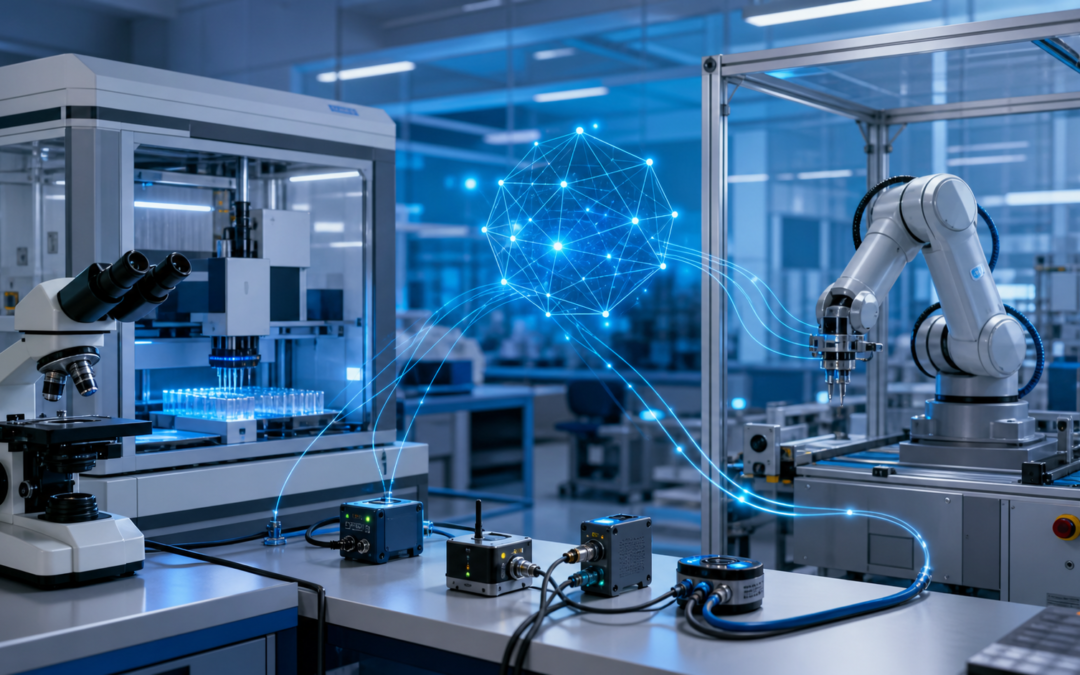
AI agents are moving beyond chat windows and software tools. Anthropic has introduced a research preview of the Model Hardware Standard (MHS), a shared specification designed to let AI agents discover, understand and safely operate physical equipment. The initial focus is scientific laboratories and advanced manufacturing, where instruments from different vendors often require expensive, custom integration work.
Announced on 27 August 2026, MHS is being tested with research labs, robotics companies and equipment manufacturers before a planned open-source release. If the approach works at scale, it could become an important bridge between agentic AI and real-world machines.
What is the Anthropic Model Hardware Standard?
The Anthropic Model Hardware Standard is a proposed common interface for programmable physical devices. It began as a collaboration between Anthropic and the Howard Hughes Medical Institute’s Janelia Research Campus, where researchers needed to coordinate lasers, cameras, motorised focusers and other specialised equipment that lacked a shared interface.
Today, connecting a microscope, robotic arm, liquid handler and plate reader can take weeks or months. Each machine may expose a different application programming interface, use different terminology and store operating knowledge in separate manuals. MHS aims to reduce that integration burden to hours or minutes by giving devices a standard software driver and a consistent way to describe their capabilities.
How MHS connects AI agents to machines
Standard drivers and simple commands
An MHS driver translates between software and a specific piece of hardware. It exposes basic primitives such as “read” and “write”, allowing software to retrieve a temperature, change a setting or trigger an action through a predictable interface. Devices also become discoverable across a network in a standard format, reducing the need to build a new translator for every combination of machines.
Machine-readable context and safety limits
Code alone may not tell an agent everything it needs to know. A robot arm’s weight, a safe temperature range or the physical consequences of a command can matter as much as the command syntax. MHS lets operators add natural-language tags describing device characteristics, adjustable settings, measurements and enforceable limits. The driver then produces a reference file the agent can use when planning a task.
MCP, command line and APIs
MHS can expose hardware through the Model Context Protocol (MCP), a command-line interface or code APIs. Anthropic says the standard is model-agnostic, so it is not limited to Claude. An agent harness that supports the relevant protocols could potentially control MHS-compatible devices, while deterministic code files can handle long-running or time-sensitive operations without requiring the model to reason through every individual step.
What early MHS trials have achieved
Anthropic reported several proof-of-concept results across biotechnology, microscopy and quantum computing. Carnegie Mellon University researchers used MHS to coordinate equipment across three computers and complete serial-dilution dose-response experiments about three times faster than before. At the University of Washington, researchers built an agent-supervised qPCR workflow and coordinated a robotic arm with a liquid handler for collision-free plate transfers.
Quantum-computing company QuEra used an AI agent and MHS to control parts of a laser system. According to Anthropic, the resulting controller recovered the laser’s required frequency “lock” 99.3% of the time without human intervention. Genentech also tested MHS in a protein-assay workflow involving a liquid handler, robotic arm and plate reader.
Hardware and software partners exploring support include AWS, Automata, Danaher, Doosan Robotics, QIAGEN, Tecan and Universal Robots. Anthropic also says Hugging Face is adding support to its LeRobot robotics library, while Raspberry Pi is enabling integrations across some products after camera-driver tests.
Why the standard matters
For researchers, a common hardware layer could make experiments easier to reproduce and reconfigure. A laboratory could replace an instrument without rebuilding its entire orchestration system, while agents could monitor several devices, react to changing measurements and help diagnose failures around the clock.
Manufacturers could benefit from faster deployment and more flexible production lines. Instead of writing a unique agent integration for every device, developers could target a shared interface. Equipment vendors may also gain a clearer path for making products discoverable by multiple AI platforms rather than one proprietary ecosystem.
For developers, MHS extends the idea behind MCP from digital data and software tools into the physical world. That creates opportunities for agent applications in laboratory automation, robotics, electronics testing, agriculture and industrial quality control. However, access is currently limited to an application-based research preview, so MHS is not yet a finished production standard.
Risks and limitations
Physical actions carry consequences that software-only agents do not face. A mistaken database query can often be reversed; a robotic collision, contaminated sample or unsafe temperature change may not be. Strong permission controls, hardware interlocks, audit logs, emergency stops and human approval for high-risk actions remain essential.
Anthropic also acknowledges that language models have limited spatial and physical reasoning. In one Genentech test, researchers had to help Claude understand that sample foaming was a physical problem rather than a software bug. MHS cannot currently connect equipment that lacks a programmable interface, and the performance figures disclosed so far come from early partner projects rather than broad independent testing.
Security is another concern. A standard interface can simplify legitimate integration, but it can also create a larger common attack surface if authentication, network isolation and command validation are weak. Organisations evaluating MHS should treat an AI agent as a privileged automation component, not as an all-knowing operator.
What to watch next
The biggest milestone will be Anthropic’s planned open-source release. Developers should watch for the specification, reference drivers, licensing terms, governance model and independent safety evaluations. Interoperability testing across models and vendors will determine whether MHS becomes a widely adopted standard or remains one of several competing approaches.
It will also be important to see how the standard handles identity, granular permissions, real-time constraints, failure recovery and certification for safety-critical environments. Adoption by established equipment makers could be as decisive as support from AI companies.
Conclusion
The Model Hardware Standard is an ambitious attempt to give AI agents a common language for the physical world. Early demonstrations suggest it can reduce integration time and coordinate complex experiments, but the project is still a limited research preview. Its long-term value will depend on open governance, vendor interoperability and safety controls that remain reliable when an agent’s reasoning does not.
Sources
- Anthropic — Previewing the Model Hardware Standard
- Model Hardware Standard — Official research preview site
- Anthropic — Introducing the Model Context Protocol
- HHMI — Janelia Research Campus