
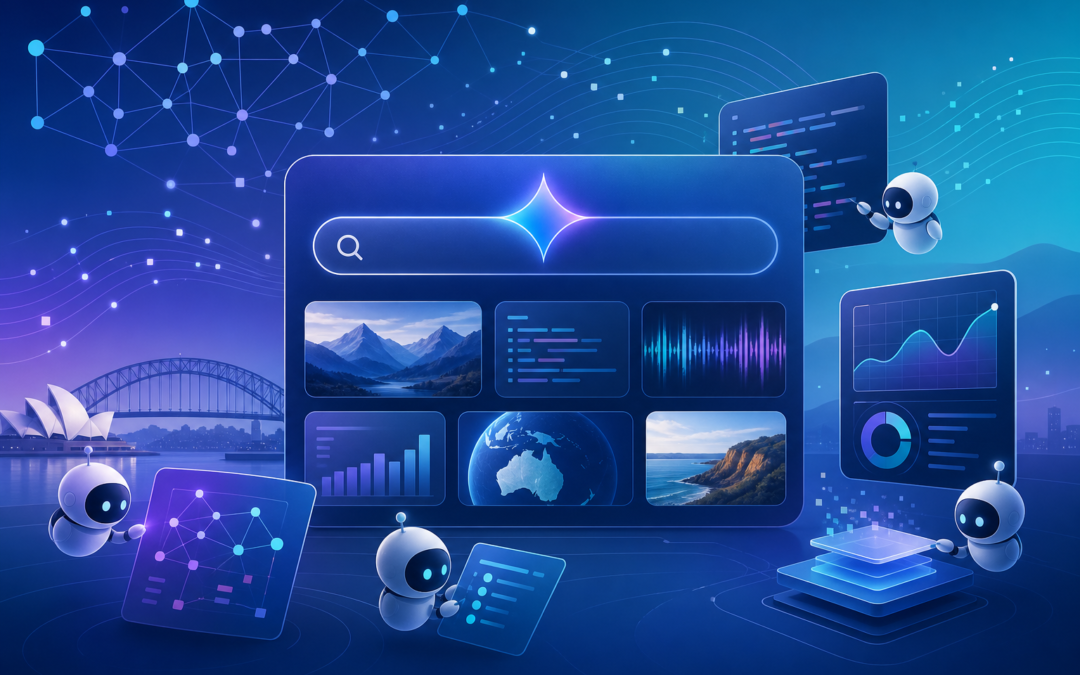
Google Gemini 3.5 Flash is one of the most important AI updates from Google I/O 2026 because it pushes fast, agent-style AI into two places people already use every day: Google Search and developer workflows. Google says the model is designed to combine “frontier intelligence with action,” with a focus on agents, coding, multimodal inputs and lower-latency responses.
That makes this more than a benchmark announcement. If Google’s rollout works as described, AI Search will become less like a static results page and more like a workspace that can understand files, images, videos and open tabs, then assemble custom answers, dashboards or mini tools. For businesses, creators and developers, the change points to a near future where AI agents are built into mainstream productivity rather than kept inside specialist apps.
Background: Google is moving Search into an agentic AI era
Google has spent the past few years layering generative AI into Search through AI Overviews and AI Mode. At I/O 2026, the company said AI Mode has passed one billion monthly users, with queries more than doubling every quarter since launch. Google also said AI Overviews now reaches more than 2.5 billion monthly active users.
Those numbers matter because they show AI-assisted search is no longer an experiment for early adopters. Search is becoming one of the largest distribution channels for generative AI, and the model powering it can shape how people research products, learn skills, compare services, plan travel, write code and make buying decisions.
What changed with Gemini 3.5 Flash?
Google announced Gemini 3.5 Flash as the first model in a new Gemini 3.5 series. The company says it is generally available through Google Antigravity, the Gemini API in Google AI Studio and Android Studio. It is also becoming the default model in AI Mode globally.
Faster model, stronger agent focus
The key message is speed plus action. Google positions Gemini 3.5 Flash as a model for long-horizon agentic tasks, coding work and real-world workflows. In its I/O summary, Google cited benchmark results including Terminal-Bench 2.1 at 76.2%, GDPval-AA at 1656 Elo and MCP Atlas at 83.6%, while saying the model outperforms Gemini 3.1 Pro on several coding and agentic benchmarks.
Benchmarks should not be treated as the whole story, but they indicate Google is targeting practical tasks: maintaining codebases, creating applications, preparing documents, producing richer web interfaces and coordinating multi-step jobs.
AI Mode gets a major Search upgrade
Google’s Search team says Gemini 3.5 Flash is now the default model in AI Mode for users globally. The company is also rolling out an intelligent AI-powered Search box that can accept text, images, files, videos and Chrome tabs as inputs. In other words, a query can be less like a keyword phrase and more like a bundle of context.
Google also describes a smoother path from AI Overviews into AI Mode, so users can ask follow-up questions while keeping context. This is important for complex searches where the first answer is only the start: researching a laptop purchase, planning a move, comparing software tools, learning a technical topic or troubleshooting a business process.
Search agents and generative interfaces
One of the most interesting announcements is Search agents. Google says users will be able to create and manage multiple agents in Search, starting with information agents that monitor the web, news, social posts and real-time data for changes related to a user’s question. These are expected to roll out first to Google AI Pro and Ultra subscribers.
Google is also bringing Antigravity and Gemini 3.5 Flash into Search so it can generate custom interfaces on the fly. Instead of only returning links and summaries, Search may create visual tools, tables, graphs, simulations or mini experiences tailored to the question.
Why it matters
The practical value is that AI becomes more embedded in everyday discovery. Users may spend less time stitching together information from many tabs and more time refining a goal. Developers may be able to prototype faster. Businesses may use agentic systems to monitor competitors, summarize market changes, prepare reports or automate repetitive knowledge work.
For publishers and website owners, this is also a signal that SEO is changing again. If Search increasingly answers with AI-generated layouts and agent-driven summaries, content needs to be clear, original, well-structured and genuinely useful. Pages that provide first-hand expertise, accurate data, practical comparisons and strong topical authority are more likely to remain valuable in an AI Search environment.
Practical impact for users, businesses and developers
For everyday users, Gemini 3.5 Flash could make AI Mode quicker and more capable for broad tasks: planning, research, troubleshooting, shopping and learning. The ability to use files, videos and open tabs as inputs may also reduce the friction of explaining a problem from scratch.
For businesses, the bigger shift is monitoring and workflow automation. Information agents could watch for market changes, product availability, policy updates or customer topics. If those agents can present concise updates and suggested actions, teams may use Search as a lightweight intelligence layer.
For developers, the model’s coding and agentic focus is the headline. Google Antigravity, Google AI Studio and Gemini Enterprise give developers multiple routes to build and orchestrate agents. The promise is faster iteration, lower latency and more cost-effective agent workflows, especially where a task requires repeated reasoning rather than one long answer.
Risks, limitations and concerns
The first concern is reliability. AI agents that monitor the web or generate interfaces must handle conflicting sources, outdated pages and misleading content. Users should still check original sources before acting on financial, health, legal or safety-related information.
The second concern is transparency. As AI Search summarizes more of the web, users need clear source links and confidence that important context has not been lost. Publishers will also watch how traffic patterns change when answers become more complete inside Search itself.
Privacy is another issue. Multimodal inputs and connected context can be powerful, but users should understand what they are sharing and which apps or tabs are connected. Google says personalisation features are designed around user control, but the safest habit is to connect only what is necessary.
What to watch next
The next milestones are the rollout of information agents, generative UI in Search and wider enterprise access through Google Cloud. Google also said Gemini 3.5 Pro is in testing and expected after Flash, which could raise expectations for deeper reasoning and more complex agent workflows.
It will also be worth watching how competitors respond. OpenAI, Anthropic, Microsoft and Perplexity are all pushing toward agentic research, coding and workplace automation. Google’s advantage is distribution: Search, Chrome, Android, Workspace and Cloud give it many places to put AI directly in front of users.
Conclusion
Google Gemini 3.5 Flash is important because it brings fast agentic AI closer to mainstream search and everyday work. The update is not just about a new model name; it is about changing what Search can do, from answering questions to monitoring topics, building custom interfaces and helping users act on information.
For users, the benefit is convenience. For developers, it is a faster platform for building agents. For businesses, it could become a new way to track change and automate research. The trade-off is that accuracy, privacy and source transparency will matter more than ever as AI Search becomes more active.
Sources
- Google Blog: 100 things we announced at I/O 2026
- Google Search Blog: A new era for AI Search
- Google Cloud Blog: Everything Google Cloud customers need to know coming out of Google I/O
- Google Blog: I/O 2026: Welcome to the agentic Gemini era