
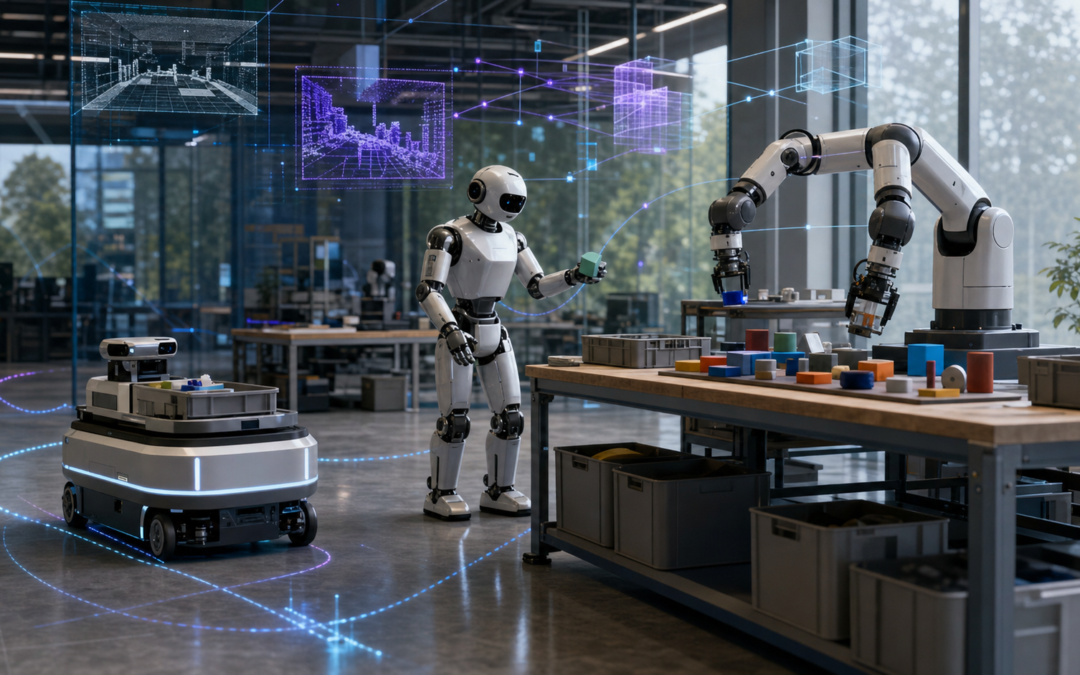
Gemini Robotics ER 2 is Google DeepMind’s newest embodied-reasoning model, designed to help robots understand what they see, plan longer tasks, use tools and coordinate with other machines. Announced on 30 July 2026, it is one of the clearest signs yet that generative AI is moving beyond screens and into the physical world.
The model is now available to developers in public preview through the Gemini API and Google AI Studio, while access through the Gemini Enterprise Agent Platform is in private preview. That makes this more than a research demonstration: developers can begin testing its reasoning layer with real robotic systems.
Background: why embodied AI is different
Most familiar AI assistants work with digital information. Robots face a harder problem. They must interpret changing scenes, understand space and time, decide what to do next and hand instructions to control systems that move physical hardware. An error in a document can be corrected; an error by a moving machine can damage equipment or put people at risk.
Embodied AI therefore combines several disciplines: computer vision, language understanding, spatial reasoning, planning, robot control and safety engineering. Google’s “ER” label stands for embodied reasoning. The model operates as a high-level intelligence layer rather than directly replacing every low-level motor controller.
What Google changed with Gemini Robotics ER 2
According to Google, Gemini Robotics ER 2 improves three areas in particular: video understanding, multi-step tool orchestration and multi-robot collaboration. It is a vision-language model based on Gemini 3.5 Flash and accepts interleaved text, images, video and audio. Its published model card lists a context window of up to 128,000 tokens.
Better understanding of activity over time
A robot does not only need to recognise an object in one frame. It may need to determine when a step occurred, whether a process is complete or why progress stopped. Google’s developer documentation highlights video moment finding and video progress classification, capabilities intended to help systems reason across a sequence rather than treat every image independently.
This could be useful for tasks such as monitoring an assembly process, checking whether items were sorted correctly or deciding when another robot should take over. However, these capabilities should still be tested in the specific lighting, camera position and operating conditions of each deployment.
Multi-step tool use and robot teams
Gemini Robotics ER 2 can plan across tools exposed by a developer, such as navigation functions, action models or specialised robot interfaces. Instead of producing a single answer, the system can select and sequence tools to pursue a goal.
Multi-robot orchestration extends that idea to teams of machines. A high-level model can consider which available robot is suitable for each part of a task and coordinate their work. That matters because warehouses, laboratories and factories often use mixed fleets rather than one universal robot.
Why Gemini Robotics ER 2 matters
The release may lower the barrier to prototyping smarter robot applications. Previously, a team might have needed separate systems for visual analysis, natural-language instructions, task planning and fleet coordination. A multimodal reasoning model provides a shared interface across those stages, even though developers still need control software, sensors and safety systems.
For businesses, the practical opportunity is flexibility. Traditional automation performs well in predictable environments but can be expensive to reconfigure. A system that understands video and natural-language goals may adapt more easily when the task, object or workspace changes. Potential uses include logistics, inspection, research labs, assisted manufacturing and service robotics.
For developers, public-preview access is significant. Google lists the standard model as gemini-robotics-er-2-preview. Teams can experiment through the Gemini API or Google AI Studio, connect declared tools and assess whether the model’s plans are reliable enough for a controlled pilot.
Practical impact for developers and businesses
A sensible first project is a bounded workflow with reversible actions. For example, a robot could inspect trays, identify incomplete steps and recommend the next action before a person approves execution. This makes it easier to measure perception and planning quality without immediately granting autonomous control.
Developers should separate high-level reasoning from safety-critical motion. The AI model can propose a plan, while deterministic software enforces speed limits, collision boundaries, tool permissions and emergency-stop behaviour. Logging video inputs, tool calls, decisions and outcomes is also essential for debugging.
Businesses evaluating the technology should focus less on impressive demonstrations and more on operational metrics: task completion rate, intervention frequency, latency, network dependency, cost per task and performance under unusual conditions. A robot that succeeds in a curated demo may still struggle with clutter, reflections, occlusion, noise or unfamiliar objects.
Risks, limitations and safety concerns
Gemini Robotics ER 2 is a preview model, not a guarantee of safe autonomy. Like other vision-language models, it can misinterpret a scene, make an incorrect assumption or produce a plausible plan that is unsuitable for the hardware. Long context also does not ensure that every earlier detail will be used correctly.
Privacy is another concern because cameras and microphones may capture workers, customers or confidential environments. Organisations need clear rules for data collection, retention and access. They should also consider what happens if the cloud connection is interrupted or a malicious instruction reaches the system through visible text, audio or a connected tool.
Google’s model card provides information about limitations, mitigations and safety evaluation, but deployers remain responsible for testing the complete system. Physical safeguards, restricted permissions, human oversight and scenario-based evaluation are not optional extras.
What to watch next
The key question is whether embodied-reasoning models can move from carefully controlled pilots to dependable everyday operation. Watch for independent evaluations, supported hardware integrations, pricing at production scale and evidence that multi-robot coordination works reliably outside research environments.
It will also be important to see how Google’s broader Gemini Robotics 2 work connects high-level reasoning with whole-body control and dexterous manipulation. DeepMind has presented a wider family of robotics models, but ER 2 is the component currently open for broad developer experimentation.
Conclusion
Gemini Robotics ER 2 gives developers a practical entry point into Google’s latest robot AI stack. Its combination of multimodal video understanding, multi-step tool use and robot-team planning is technically meaningful, especially now that the model is accessible through familiar Gemini development tools.
The opportunity is smarter, more adaptable automation. The challenge is turning probabilistic AI reasoning into physical actions without weakening safety, privacy or accountability. Teams that start with narrow tasks, strong guardrails and measurable tests will learn far more than those chasing full autonomy from day one.
Sources
- Google DeepMind: Gemini Robotics 2 brings whole body intelligence to robots
- Google: Introducing Gemini Robotics ER 2
- Google DeepMind: Gemini Robotics ER 2 model card
- Google AI for Developers: Gemini Robotics ER overview
- Ars Technica: Google reveals Gemini Robotics 2.0