
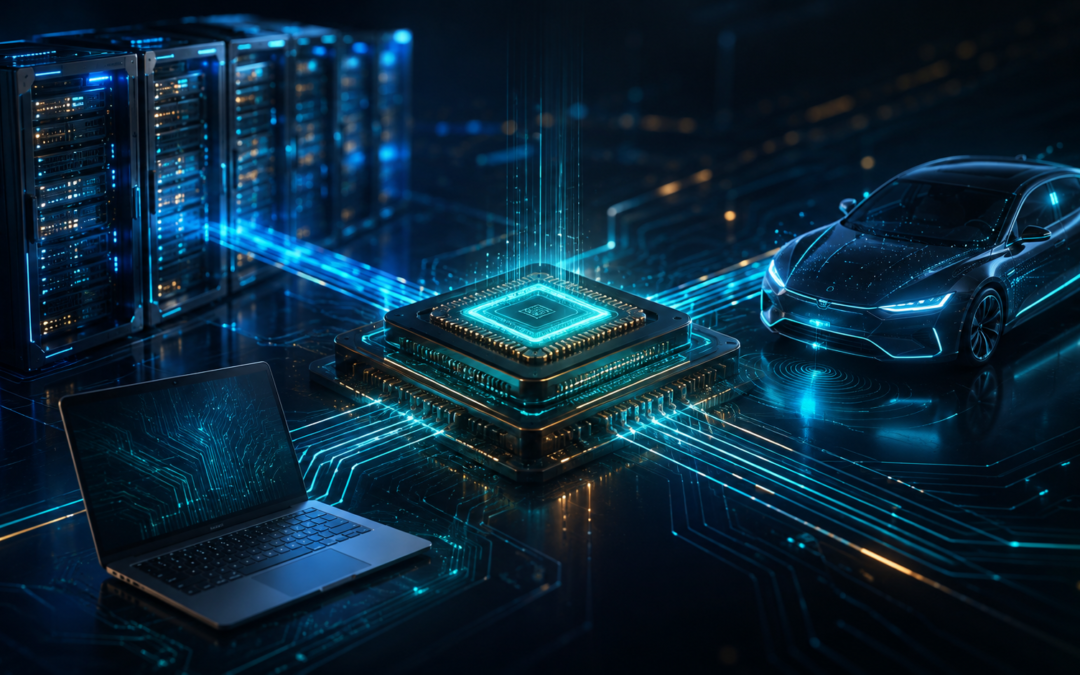
NVIDIA and MediaTek have significantly expanded their semiconductor partnership, linking custom data-centre accelerators, next-generation AI PCs and software-defined vehicles. The deal includes a US$3.5 billion NVIDIA investment in MediaTek convertible bonds and MediaTek’s adoption of NVIDIA’s NVLink Fusion platform.
For cloud operators, device makers and developers, this is more than a financial transaction. It is an attempt to make NVIDIA’s interconnect and software ecosystem a common foundation for specialised AI chips from the data centre to the edge.
Background: why custom AI chips are gaining ground
Training and running large AI models requires enormous computing capacity, but not every workload needs the same processor. Major cloud companies increasingly design custom accelerators—often called XPUs—to improve performance, power efficiency or cost for particular jobs.
The difficulty is that a processor is only one part of a production AI system. Companies must also solve high-speed chip-to-chip communication, memory bandwidth, advanced packaging, networking, manufacturing and rack-level integration. That complexity can delay a custom design long after its core architecture looks promising.
NVIDIA has responded with NVLink Fusion, a platform intended to connect custom processors to NVIDIA’s wider rack-scale infrastructure. MediaTek brings experience in custom silicon, power-efficient system-on-chip design, connectivity and packaging. Their expanded collaboration is designed to combine those strengths.
What NVIDIA and MediaTek announced
Announced on 31 August 2026, the expanded NVIDIA MediaTek partnership has three principal areas: AI infrastructure, local AI computing and automotive technology. NVIDIA also invested US$3.5 billion in convertible bonds issued by MediaTek.
NVLink Fusion for custom AI infrastructure
MediaTek will offer NVLink Fusion as a design foundation for customers building custom AI accelerators. According to NVIDIA, this gives hyperscalers, cloud providers and frontier-model developers a prevalidated route for integrating their XPUs with NVLink-connected, rack-scale systems.
The platform includes an NVLink Fusion chiplet for joining custom processors to NVIDIA’s scale-up fabric, NVLink-C2C for high-bandwidth links between compatible processors, and NVHBM for customised high-bandwidth memory integration. MediaTek customers will be able to tailor factors such as memory, connectivity, packaging, performance and power consumption around their workloads.
The practical pitch is speed and reduced engineering risk. Instead of qualifying every surrounding component from scratch, a chip designer can concentrate on the distinctive compute logic while relying on a more established route to packaging, memory and rack deployment.
More powerful local AI computers
The companies also plan to collaborate across multiple generations of RTX Spark and DGX Spark chips for consumer PCs, developer systems and enterprise workstations. They have already worked together on the GB10 Grace Blackwell Superchip used in DGX Spark, which combines an NVIDIA GPU and Grace CPU through NVLink-C2C.
The next stage extends that relationship into RTX Spark-powered Windows PCs. The broader aim is to run increasingly capable generative and agentic AI workloads locally, rather than sending every task to a remote cloud service.
AI-powered vehicles
In automotive computing, MediaTek’s Dimensity Auto platforms integrate NVIDIA technology for intelligent cockpits, AI features and RTX graphics, and can work alongside NVIDIA DRIVE AGX. The companies say they will continue this work over multiple product generations as vehicles become more software-defined and use more on-device AI.
Why the partnership matters
The deal strengthens NVIDIA’s position even when a customer chooses a custom accelerator instead of an NVIDIA GPU for part of an AI workload. If those chips still depend on NVLink connectivity, NVIDIA software and NVIDIA-compatible rack architecture, the company remains central to the finished system.
For MediaTek, the agreement could accelerate its expansion beyond smartphone chips. CNBC notes that the company has been diversifying into data-centre silicon, a market where cloud operators want alternatives and workload-specific designs. Access to the NVLink Fusion ecosystem may make MediaTek a more credible partner for customers that need custom chips without building every layer themselves.
The partnership also connects cloud and edge strategy. Common technologies across AI factories, workstations, PCs and cars may help developers move models between environments with fewer integration barriers, although real portability will depend on the software and hardware delivered.
Practical impact for users, businesses and developers
- Cloud businesses: Custom accelerators could reach production faster if prevalidated interconnect, memory and rack designs reduce integration work.
- Enterprise IT teams: More capable local AI workstations may keep sensitive workflows on-premises and reduce latency, but organisations will still need governance and security controls.
- Developers: NVIDIA-compatible custom silicon may broaden hardware choices while preserving access to a familiar accelerated-computing stack.
- PC users and creators: Future RTX Spark systems could run larger AI assistants, media tools and agent workflows locally, potentially improving privacy and responsiveness.
- Automakers: A reusable platform spanning cockpit graphics and AI could simplify development across vehicle models and generations.
Risks and limitations
Most of the announcement describes a roadmap, not a set of independently benchmarked products. Pricing, specifications, availability and customer adoption remain uncertain. The companies themselves warn that product development, manufacturing capacity, competition and market acceptance could affect the outcome.
There is also a strategic trade-off for customers. NVLink Fusion may reduce engineering complexity, but deeper use of NVIDIA interconnects and software could increase ecosystem dependence. Buyers should evaluate long-term licensing, supply-chain resilience, interoperability and the cost of moving workloads elsewhere.
Local AI also does not automatically guarantee privacy or safety. Device makers must provide secure model storage, clear data controls, reliable updates and transparent cloud fallback behaviour. Automotive uses face an even higher bar because failures can affect safety as well as convenience.
What to watch next
The most important evidence will be named customer designs, production timelines and measured performance. Watch for the first MediaTek-built custom XPUs using NVLink Fusion, detailed specifications for RTX Spark PCs, and confirmation of when those systems ship at scale.
It will also be worth tracking whether cloud providers adopt the platform for major workloads and whether competing interconnect standards can match its deployment momentum. In vehicles, concrete model announcements and safety validation will matter more than demonstrations.
Conclusion
The expanded NVIDIA MediaTek partnership is a broad bet on connected AI computing. It gives MediaTek a stronger path into custom data-centre silicon while helping NVIDIA extend its ecosystem beyond its own GPUs. If the companies deliver, businesses could gain a shorter route to specialised AI infrastructure and users could see more capable local AI in PCs and cars. For now, the promise is substantial, but production hardware, benchmarks and customer adoption will determine its real impact.