
Focus keyword: physical AI robots
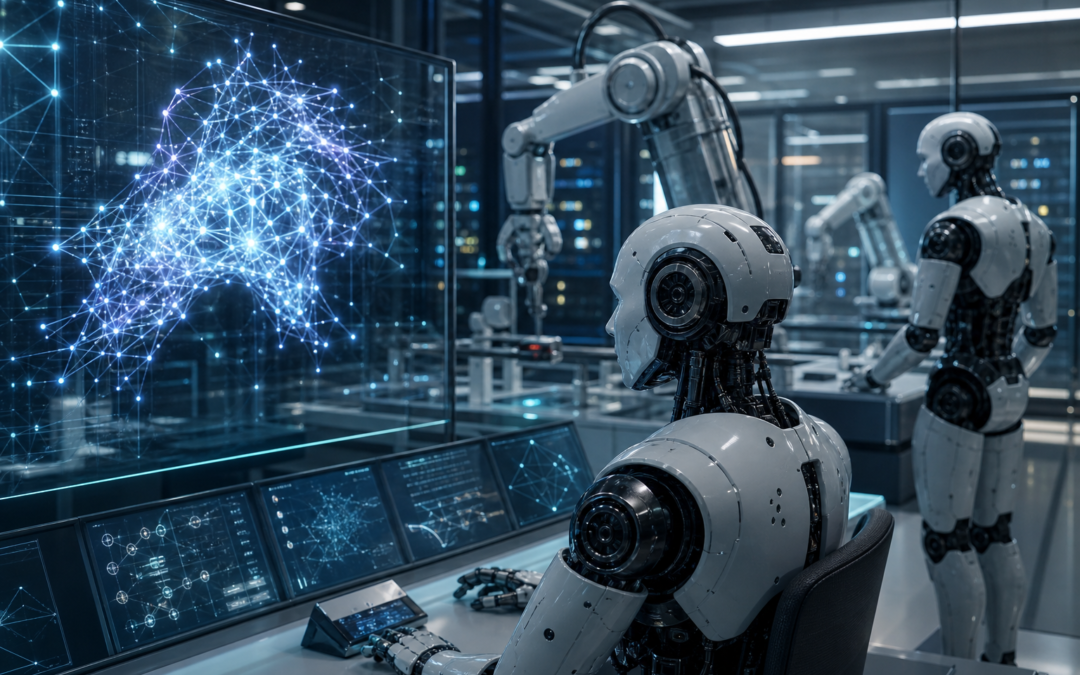
NVIDIA has made another major move in physical AI robots, releasing new open models, simulation tools and edge-computing hardware aimed at helping developers build robots that can understand, reason and act in the real world.
The announcement matters because robotics is moving beyond pre-programmed machines that repeat narrow tasks. The next stage is likely to be robots that can learn from simulation, adapt to messy environments and use AI reasoning to complete jobs in factories, hospitals, warehouses, farms and eventually homes. NVIDIA is trying to provide the full stack behind that shift: models, development frameworks, simulation, cloud orchestration and on-device chips.
Background: why physical AI is becoming a major tech battleground
For years, the most visible AI breakthroughs have happened on screens: chatbots, coding assistants, image generators and productivity copilots. Robotics is harder. A robot needs to process vision, language, motion, balance, safety constraints and changing real-world conditions at the same time. It cannot simply produce a plausible answer; it has to move correctly.
This is why the phrase physical AI has become important. It refers to AI systems that understand the physical world and can plan actions inside it. A warehouse robot, a surgical assistant, a mining vehicle or a humanoid helper all need this type of intelligence. They need perception, reasoning and control, not just text generation.
NVIDIA already plays a central role in AI training and data centre hardware. Its latest robotics announcement shows how aggressively it wants to extend that role to machines operating at the edge, where AI must run locally, quickly and reliably.
What NVIDIA announced
According to NVIDIA, the company has released new open models, frameworks and AI infrastructure for physical AI. The headline releases include new NVIDIA Cosmos models for world modelling and synthetic data, a new Cosmos Reason vision-language model, and an Isaac GR00T model designed for humanoid robot control.
The company also introduced Isaac Lab-Arena, an open-source framework for evaluating robot policies in simulation, and OSMO, a cloud-native orchestration framework for coordinating robot-development workflows such as synthetic data generation, model training and software-in-the-loop testing across different compute environments.
NVIDIA also said it is working with Hugging Face to integrate Isaac and GR00T technologies into the open-source LeRobot ecosystem. That is notable because open robotics tooling can reduce the barrier for researchers, startups and developers who do not have the budget to build every part of a robot AI pipeline from scratch.
New open models for robot learning
The most important part of the announcement is the focus on open models. NVIDIA described Cosmos Transfer and Cosmos Predict as world models that can help generate physically based synthetic data and evaluate robot policies in simulation. Cosmos Reason is positioned as a vision-language model for machines that need to see, understand and act. Isaac GR00T N1.6 is aimed specifically at humanoid robots and full-body control.
This combination points to a practical workflow: create training data in simulation, test robot behaviours before deployment, fine-tune models for a target machine and then run them on edge hardware. That workflow is not new in concept, but NVIDIA is trying to make it more integrated and accessible.
Jetson T4000 and edge AI hardware
NVIDIA also announced the Jetson T4000 module, bringing Blackwell-based AI computing to autonomous machines and general robotics. The company says the module delivers four times the energy efficiency and AI compute of the previous generation, with 64GB of memory and a configurable 70-watt envelope.
That matters because robots cannot always rely on constant cloud connectivity. A robot working in a warehouse aisle, hospital room or construction site may need to make fast local decisions. Better edge AI hardware can support lower latency, stronger privacy and more reliable operation when connectivity is poor.
Why it matters for businesses and developers
For businesses, the most immediate impact is likely to be faster experimentation. A manufacturer or logistics company does not necessarily want to become a frontier AI lab. It wants to know whether robots can reduce repetitive work, improve safety or expand operating hours. More mature simulation and evaluation tools can make pilot projects cheaper and less risky.
For developers, open robotics models and frameworks could create a more practical entry point into the field. Instead of building perception models, action models, simulation pipelines and deployment tooling independently, teams may be able to start with NVIDIA and Hugging Face components, then customise them for a specific robot or task.
For startups, this could be especially useful. Robotics companies often fail not because the demo is impossible, but because scaling from a controlled demo to a reliable product is brutally expensive. Better synthetic data, repeatable benchmarks and integrated orchestration can shorten the distance between prototype and deployment.
Practical impact: where physical AI robots may appear first
The first broad wave of AI-powered robotics is unlikely to be general-purpose home assistants. The stronger near-term opportunities are commercial and industrial: warehouse picking, autonomous inspection, factory assistance, healthcare support, agriculture, mining, construction and delivery.
These environments have clear tasks, measurable return on investment and, in many cases, labour shortages or safety risks. A robot that can inspect equipment, move materials, assist a technician or navigate a structured facility has a more realistic business case than a consumer humanoid expected to do everything.
The healthcare examples are also worth watching, especially where AI can support imaging, guidance, training or semi-autonomous assistance under professional supervision. However, healthcare robotics will face stricter safety, regulatory and liability requirements than warehouse or industrial use cases.
Risks, limitations and concerns
The excitement around physical AI should be balanced with caution. Robots create physical risk. A chatbot error can be embarrassing or costly; a robot error can damage property or injure someone. That means evaluation, redundancy, human oversight and clear safety boundaries are essential.
There are also workforce concerns. Robotics can improve safety and productivity, but it can also change job requirements or reduce demand for some roles. Businesses adopting robots should plan for training, redeployment and transparent communication with workers.
Another limitation is that simulation is never a perfect copy of the real world. Synthetic data and simulated testing are powerful, but robot systems still need real-world validation across edge cases: lighting changes, clutter, human behaviour, hardware wear, network issues and unexpected obstacles.
What to watch next
The next key question is adoption. Watch whether robotics developers actually use the new Cosmos, Isaac, GR00T and LeRobot integrations in public projects, research papers and commercial pilots. Tooling announcements are useful, but the real proof will be stronger robots that can perform reliable tasks outside staged demos.
It will also be important to watch pricing and availability of the Jetson T4000 and related Thor-powered systems. Affordable and efficient edge hardware could help smaller robotics companies compete, while expensive or supply-constrained hardware would limit adoption.
Finally, expect more competition. Google DeepMind, Tesla, Figure AI, Boston Dynamics, Meta, OpenAI-backed robotics efforts and many university labs are all working on pieces of the physical AI puzzle. NVIDIA’s advantage is not only its models, but its ability to connect AI infrastructure, developer software and chips into one ecosystem.
Conclusion
NVIDIA’s latest physical AI announcement is not just another robotics press release. It signals a broader shift from isolated robot demos toward reusable AI models, open development frameworks and edge hardware built for real-world autonomy.
If the tools work as promised, developers could build and test robot behaviours faster, businesses could run more practical automation pilots, and the open-source robotics community could gain a stronger foundation. The opportunity is huge, but so are the safety, reliability and labour questions.
For now, physical AI robots remain an emerging field rather than a finished product category. But NVIDIA’s new models and infrastructure make one thing clear: the race to bring AI out of the screen and into the physical world is accelerating.
Sources
- NVIDIA Newsroom: NVIDIA Releases New Physical AI Models as Global Partners Unveil Next-Generation Robots
- NVIDIA Isaac Robotics Platform: https://developer.nvidia.com/isaac
- Hugging Face LeRobot: https://huggingface.co/lerobot