
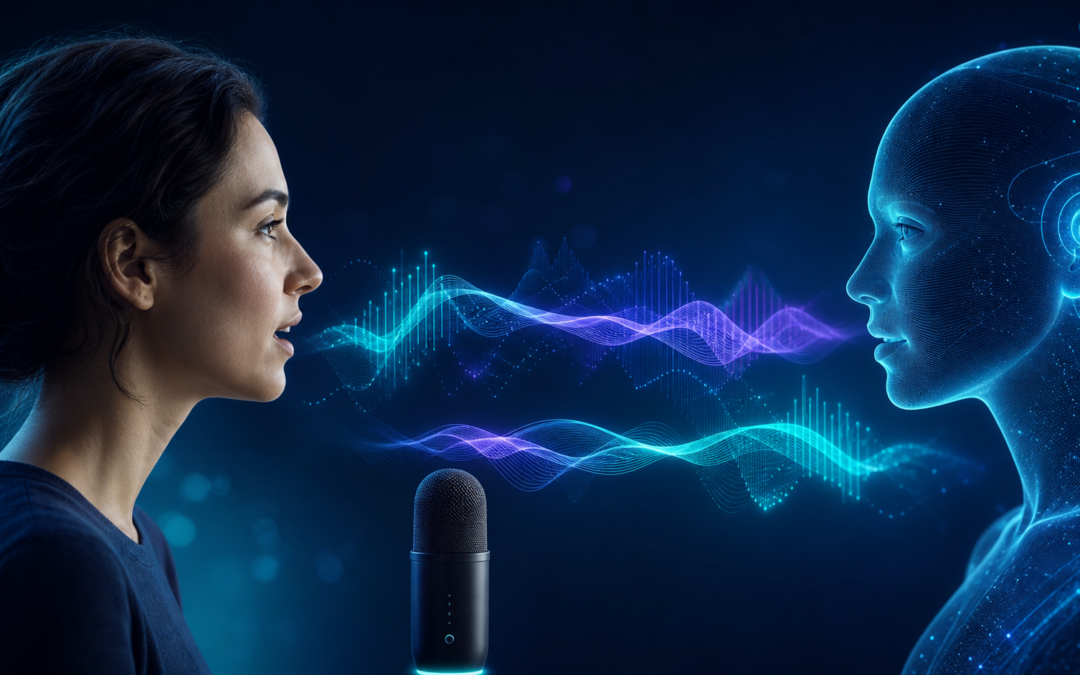
OpenAI has added SynthID watermarking to supported audio generated by GPT-Live, strengthening the transparency story around its newest real-time voice technology. The update, dated 31 July 2026, follows the launch of GPT-Live earlier in July and matters because AI speech is becoming faster, more natural and harder to distinguish from a human conversation.
What is OpenAI GPT-Live?
GPT-Live is OpenAI’s new generation of voice models for live human–AI conversations. OpenAI began rolling out two versions—GPT-Live-1 and GPT-Live-1 mini—to ChatGPT users globally on 8 July 2026. The larger model is aimed at higher-capability experiences, while the mini version provides a lighter option.
The defining change is its full-duplex architecture. In an ordinary voice assistant, the system usually waits for the user to finish, converts speech into text, generates an answer and then reads that answer aloud. That sequence can produce awkward gaps and makes interruptions feel unnatural.
GPT-Live can listen and speak at the same time. It can acknowledge a speaker with a brief response, handle rapid back-and-forth exchanges and remain quiet when someone pauses to think. Users can also interrupt it more naturally. OpenAI says GPT-Live now powers ChatGPT Voice, bringing these improvements into a product that many people already use.
What changed in the latest GPT-Live update?
SynthID watermarking arrives for supported audio
In an update posted on 31 July, OpenAI said supported audio generated with GPT-Live through ChatGPT Voice and the OpenAI API now includes SynthID watermarking. SynthID is designed to place an imperceptible signal into AI-generated content so compatible detection systems can identify its origin without adding an audible announcement or visible label.
The wording “supported audio” is important. It should not be interpreted as a guarantee that every recording encountered online can be reliably classified, nor that watermarking alone eliminates misuse. Audio can be edited, re-recorded or passed through other processing systems, while detection tools have their own limits.
A more conversational voice model
The watermarking update sits on top of GPT-Live’s main product advance: more fluid conversation. Full-duplex speech allows an assistant to respond to timing and turn-taking rather than treating every interaction as a rigid series of recorded voice notes.
Independent launch coverage also highlighted use cases such as live translation and voice agents that can be interrupted. OpenAI’s Realtime API documentation explains that developers can keep a session open while an application sends audio, receives events and updates the session state. That architecture is useful for customer support, tutoring, accessibility tools and hands-free assistants.
Why GPT-Live matters
Voice is one of the most accessible ways to use AI. It removes the need to type, works well when a user is moving or multitasking, and can make complex software easier for people who are less comfortable with traditional interfaces. Better timing and interruption handling could make an AI assistant feel less like a call-centre menu and more like a collaborative tool.
For businesses, that may translate into more capable phone support, appointment handling, guided onboarding and multilingual assistance. Developers can build conversational interfaces that react immediately instead of stitching together separate speech-to-text, language-model and text-to-speech stages. Creators may use the technology for brainstorming, rehearsal or spoken research workflows.
The practical benefit is not simply a more human-sounding voice. A low-friction conversation can let users correct an assistant quickly, ask follow-up questions before it finishes a long answer and keep working while a complex task continues in the background.
Practical impact for users and developers
For ChatGPT users
Users should notice faster, more natural exchanges in ChatGPT Voice, especially when interrupting, changing direction or speaking in shorter bursts. As with any staged rollout, exact availability and model access can depend on account tier, platform and region.
For businesses and app builders
Teams evaluating GPT-Live should test it under real conditions rather than relying only on polished demonstrations. Important measurements include response latency, interruption accuracy, transcription quality across accents, behaviour in noisy rooms, escalation to a human and total API cost.
Developers should also design clear consent and disclosure flows. People need to know when they are talking to an AI, whether a call is being recorded, how transcripts are stored and when a human can review the interaction. Watermarking is a useful technical safeguard, but it does not replace transparent product design.
Risks, limitations and concerns
More realistic AI speech creates clear risks. Voice systems can be used for impersonation, social engineering and misleading recordings. An AI may also sound confident while providing incorrect information, which is particularly dangerous in health, financial, legal or emergency contexts.
Privacy is another concern. Live voice applications can process sensitive conversations, background speech and ambient sounds. Organisations should minimise data collection, set retention limits, protect access to recordings and provide a simple way to opt out. High-stakes actions—such as payments, account changes or identity checks—should require stronger verification than a convincing voice.
There are also performance limitations. Natural turn-taking varies by language, accent, connection quality and background noise. A system that works well in a quiet demo may struggle in a car, café or busy contact centre. Human escalation and a text alternative remain essential.
What to watch next
The next phase will be about deployment rather than novelty. Watch for broader API availability, clearer pricing, supported regions and languages, detection tooling for SynthID-marked audio, and evidence that watermarking remains detectable after common edits.
It will also be important to see how OpenAI and competitors standardise disclosure. A watermark that only one platform can recognise has less value than interoperable provenance tools supported across services, publishers and social networks.
Conclusion
OpenAI GPT-Live pushes voice assistants toward genuine real-time conversation, while the new SynthID update adds a welcome layer of provenance for supported generated audio. The combination could unlock more useful assistants, translators and customer-service tools—but natural speech increases the need for disclosure, privacy controls and robust identity checks.
For users, the immediate change is a smoother ChatGPT Voice experience. For developers and businesses, the opportunity is larger: voice interfaces that people can interrupt and collaborate with naturally. The responsible path is to pair that convenience with clear AI identification, careful testing and human oversight.