
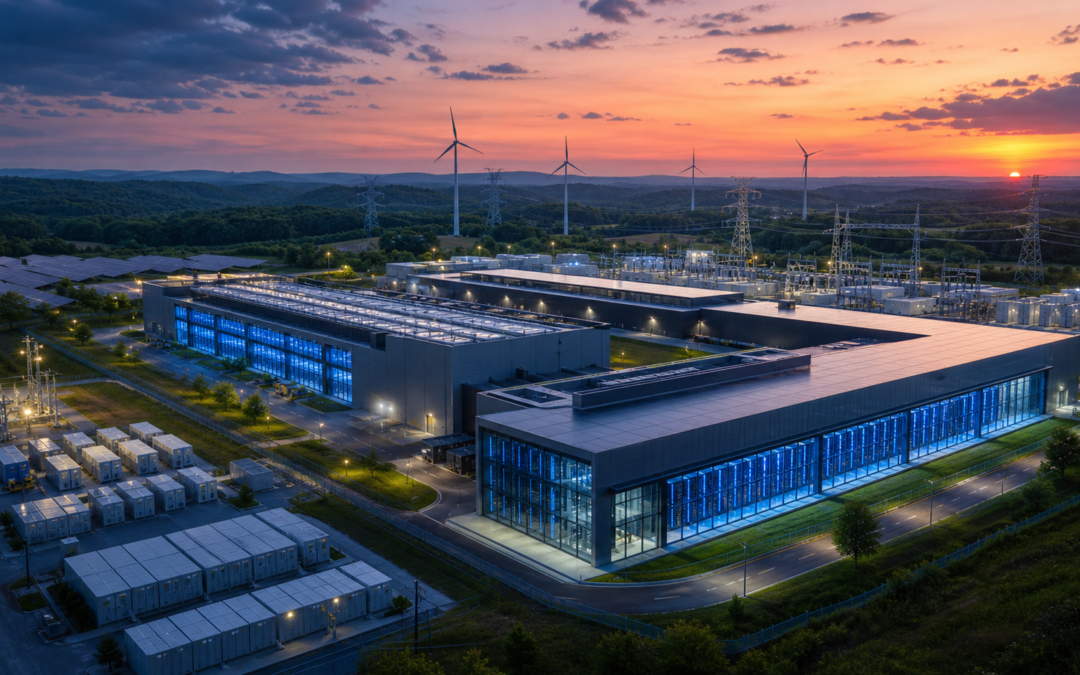
OpenAI has agreed to become the customer for a vast new artificial intelligence computing campus in Pike County, Ohio, with NVIDIA securing the infrastructure needed to fill it with its hardware. The planned OpenAI Ohio AI data centre project is notable not just for its price tag or chip supplier, but for its extraordinary power target: approximately eight gigawatts of IT capacity.
The announcement shows how the AI race is shifting beyond better models. Electricity, grid connections, land, buildings and financing are now strategic assets. For users and businesses, that could eventually mean more AI capacity and faster services—but it also raises serious questions about energy demand, delivery risk and who pays for the supporting infrastructure.
Background: AI’s bottleneck is becoming physical
Training and serving frontier AI models requires enormous clusters of accelerators connected by high-speed networks. As adoption grows, AI companies need more than GPUs: they need suitable land, reliable electricity, cooling, data-centre buildings and grid upgrades, often years before a site can operate.
PORTS-Pike is being developed around the former Portsmouth Gaseous Diffusion Plant, about 70 miles south of Columbus. SB Energy will build, own and operate the data centre, while OpenAI will lease it for 20 years. NVIDIA will be the exclusive AI compute infrastructure provider.
What NVIDIA, OpenAI and SB Energy announced
NVIDIA said the first deployment is designed for 4.25 gigawatts of IT capacity. It also has an option covering the remaining 3.75 gigawatts, bringing the site’s potential total to roughly 8 IT-GW. OpenAI has agreed to use the capacity.
The campus is expected to use NVIDIA’s full-stack DSX AI factory platform, including GPUs, CPUs and networking. NVIDIA is also investing US$1.5 billion in SB Energy and providing credit support for the site’s land, power and shell development.
Energy and grid commitments
SB Energy and SoftBank say they will build at least 10 gigawatts of new power generation to support the planned 8 IT-GW campus. The partners also committed at least US$4.2 billion for regional grid infrastructure through an arrangement with AEP Ohio. According to the announcement, the structure is intended to protect existing electricity customers from carrying the project’s infrastructure costs.
Construction and capacity are planned to arrive in phases beginning in 2028. That date matters: this is a long-term infrastructure commitment, not computing capacity that OpenAI can switch on immediately.
Local investment
The companies project tens of thousands of jobs connected to the development. They also announced an initial US$80 million community benefits fund—US$40 million previously committed by SB Energy and SoftBank, plus another US$40 million from OpenAI. Proposed priorities include affordable energy, workforce development and local economic projects.
Why the OpenAI Ohio AI data centre matters
The deal illustrates a new phase of AI competition. Model developers are trying to lock in entire campuses and their power supply rather than buying computing capacity only when it becomes available. NVIDIA, meanwhile, is expanding its role from selling chips to helping secure the physical sites where those chips will run.
At full scale, eight gigawatts of IT load would put PORTS-Pike among the world’s most ambitious AI infrastructure projects. Scale alone does not guarantee better models, but it can support more training runs, larger inference workloads and services for far more customers.
The 20-year lease also signals confidence that demand for AI computing will remain high well into the 2040s. It gives OpenAI a long runway while giving SB Energy a large anchor customer for a capital-intensive development.
Practical impact for users, businesses and developers
Nothing changes for ChatGPT or API customers today. If the campus is delivered as planned, however, additional capacity could reduce bottlenecks during periods of heavy demand and support more compute-intensive products, including coding agents, scientific tools and enterprise automation.
For developers, the broader trend is just as important as this specific facility. More infrastructure can improve model availability, but hyperscale projects also deepen dependence on a small group of AI labs, chip suppliers and cloud-scale operators. Businesses should continue to design systems with usage controls, cost monitoring and fallback providers rather than assuming unlimited, permanently cheap capacity.
For regional suppliers and workers, the phased build could create opportunities in construction, electrical engineering, networking, operations and energy. Many of the claimed job and economic benefits are forward-looking, however, and should be judged against actual contracts, hiring and completed phases.
Risks, limitations and concerns
The biggest challenge is execution. A multi-gigawatt campus requires major generation, transmission equipment, permits, cooling systems and specialised hardware. Delays in any part of that chain could change the schedule or final scale.
Energy use is another concern. The developers’ promise to add generation and fund grid upgrades is significant, but the eventual environmental impact will depend on the energy mix, water and cooling design, utilisation levels, and whether generation is genuinely additional. Community protections will also need transparent measurement over many years.
There is financial risk too. AI hardware evolves quickly, while data-centre buildings and power contracts last decades. NVIDIA says the platform will be designed for repeated upgrades, but the economics still rely on sustained demand and successful deployment at unprecedented scale.
What to watch next
Key milestones include planning and regulatory approvals, details of the power-generation mix, grid construction, equipment orders and the first operational phase in 2028. It will also be worth watching whether NVIDIA exercises its option for the additional 3.75 IT-GW and how the partners report community spending and job creation.
More broadly, similar deals will reveal whether AI infrastructure becomes concentrated in a few enormous campuses or distributed across regions and energy markets.
Conclusion
The PORTS-Pike agreement is a striking example of AI becoming an infrastructure industry. OpenAI gets a route to huge future computing capacity, NVIDIA secures an exclusive hardware footprint, and SB Energy gains a long-term customer for a power-first data-centre campus.
The potential benefits are substantial, but they remain potential until generation, grid upgrades and data-centre phases are actually completed. The project’s real test will be whether its promised capacity can be delivered from 2028 without shifting unacceptable costs or environmental burdens onto the surrounding community.